AI has changed vulnerability research forever.
Today, we're releasing the first version of Open-Kritt, an open-source platform for building and orchestrating AI-powered vulnerability research workflows.
AI can analyze code at a scale that was never practical before. As human researchers, we have to prioritize: choose which attack surfaces to explore, which code paths to follow, and where to spend our time. We simply can't cover everything.
AI can. It can inspect every entry point, trace every execution path, revisit forgotten code written a decade ago, and follow dependencies across repositories. It doesn't get bored, distracted, or tired; it just keeps going.
But AI is not perfect. It still lacks the creativity, intuition, and innovation that drive the most interesting discoveries. The most sophisticated exploit chains still come from human insight.
Open-Kritt is our attempt to bridge that gap.
Instead of replacing researchers, we want to amplify them by combining AI's ability to analyze software at massive scale with human creativity, intuition, and better tooling, all for the areas where AI still falls short.
From research to proof
What we have already done with it
We did not build Open-Kritt as a demo.
Over the last nine months, our two-person team has found over 20 real High and Critical vulnerabilities in bug bounties using this system. It found a single vulnerability that earned a $250,000 bounty, another with a $110,000 bounty, and a lot more. We also placed first in the latest Firedancer V1 audit competition with 100% AI-driven research: only Open-Kritt, with no manual review.
Our user, Blockian, is now ranked #18 on Immunefi's all-time leaderboard with more than $1M in bounties, and finished 2025 at #5.
These results are what convinced us that the underlying infrastructure is ready to be useful to other researchers, even if the product around it is still an early version.
Built in the open
Why we are making it open source
We do not pretend to have all the answers. Quite the opposite.
We believe one of the best ways to overcome the current limits of AI is to give it niche domain knowledge: researcher tricks, obscure bug examples, protocol-specific assumptions, and patterns learned from real failures.
We have spent months building this infrastructure and infusing it with ControlZ's knowledge and methods. It is going well, but we still feel like we are barely scratching the surface.
Along the way, we noticed an important distinction. Many improvements that helped our scans were not specific to one protocol or bug class. The generic parts, including splitting research into focused tasks, managing context, running agents in isolated environments, repeating searches, validating findings, deduplicating results, and ranking them, could be shared across fundamentally different areas.
The domain knowledge belongs in the workflow.
That separation is the basis of Open-Kritt. We are releasing the generic infrastructure so researchers can run their own workflows, based on their specific knowledge, tricks, and creativity.
The narrower and more specific a workflow is, the better it usually performs. A workflow based on bug patterns you understand deeply will often be more valuable than a broad prompt asking an agent to find vulnerabilities.
We have built dozens of workflows. We are releasing a few that have already helped us find multiple five-figure bounties, and we plan to release more. We also plan to open a workflow marketplace where anyone can publish and share workflows.
We believe the real magic will happen when researchers encode their own knowledge.
How the system is structured
Workflows and scans
A workflow and a scan are not the same thing.
A workflow is a reusable graph that defines how the vulnerability research should happen.
One step produces a set of outputs. The next step can launch one fresh agent for each output, with a clean context and a focused task. Or it can launch one agent for all outputs; you can read more in the batching documentation.
A simple workflow might:
- Find every externally reachable entry point in the codebase.
- Launch one agent for each entry point.
- Trace the relevant code flows from each entry point.
- Launch separate agents for each flow or bug pattern.
- Produce a set of candidate vulnerabilities.
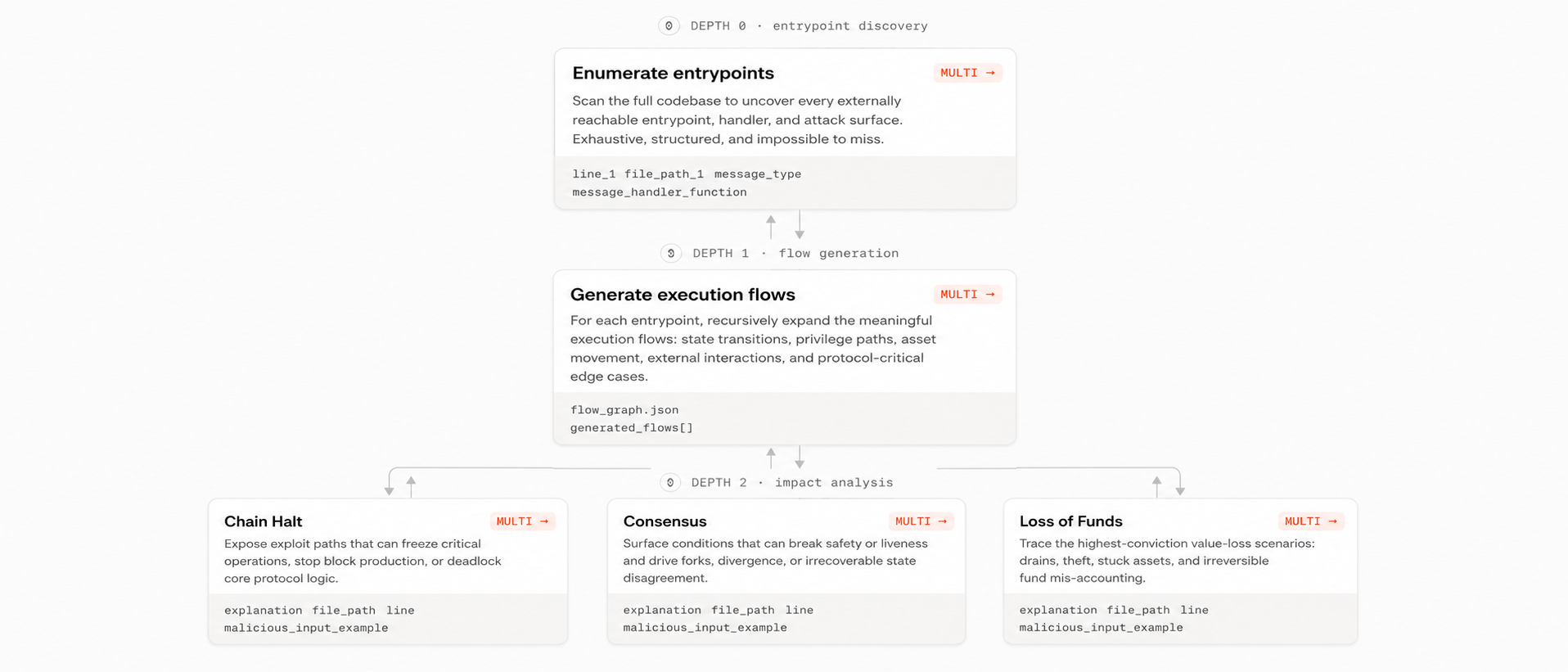
The workflow ends with candidate findings. Ranking, deduplication, and false-positive filtering are not part of the workflow itself.
A scan is one execution of a workflow against a specific target.
When creating a scan, you choose the workflow and configure the environment around it. This can include:
- The main repository
- Additional dependencies and related repositories
- Production and bounty-specific configuration
- The models and harnesses to use
- Repeat settings
- Ranker logic
- The post-script
- Other scan-specific instructions
The post-script is our name for configurable processing that happens after the workflow finishes. Depending on the scan, it can validate findings, apply additional filters, enforce reporting requirements, or perform other target-specific processing.
The raw findings produced by the workflow then pass through the scan's post-processing. This is where Open-Kritt can filter likely false positives, deduplicate repeated findings, and rank the remaining results.
Keeping these layers separate matters.
The same workflow can be used against different repositories. The same raw findings can also be processed differently depending on the bounty scope, production configuration, reporting requirements, and what the researcher considers promising.
Workflowdefines how to search.
Scandefines what to search, how to run it, and what to do with the results.
Lessons from the field
What makes Open-Kritt work
There is no single secret sauce.
Most of the work is tedious and meticulous: giving each agent the right context, the right tools, the full workspace it needs, and enough freedom to prove or disprove its theory.
These are the techniques that have mattered most for us so far.
Brute force
The clearest advantage of AI is scale.
Agents perform better when the task is specific. If tokens were free, you could give one agent every line of code and ask it one narrow question. Tokens are not free, so the useful question is where brute force gives the best return.
Two places have worked especially well for us: entry points and bounty scopes.
The first agent finds all entry points. Open-Kritt can then launch one agent for every combination of entry point and relevant scope. For the same entry point, one agent might look for a node crash, another for a chain fork, and another for a path that could lead to a loss of funds.
This is one of our simplest and most battle-tested workflows, and it is included in this release. Brute force becomes even more effective when the bug pattern is precise. We encourage researchers to take bugs they already understand and turn them into targeted workflows. Open-Kritt also includes an AI assistant that helps create workflows from a research idea or known pattern.
And yes, the more you spend, the more results you'll have. To reach first place in the Firedancer competition, we spent over $2,000 on tokens.
Models and harnesses
In our experience, stronger models generally find more complex vulnerabilities.
We use the models that perform best on our private benchmark. Right now, our strongest results come from GPT-5.6, Claude Opus 4.8, and Kimi K3.
We have also found that models often perform best inside their native coding harness. GPT models work best for us with Codex, while Opus works best with Claude Code.
Open-Kritt supports both harnesses, Codex and Claude Code, from day one, along with three model providers. You can use your existing paid ChatGPT or Claude account and its usage limits, or connect models through OpenRouter. Use whichever combination works best for your workflow and budget.
Tools and skills
The right tools matter, but we found that vulnerability research tools overlap heavily with what Codex and Claude Code already provide.
Both harnesses can inspect code, search the web, and run command-line tools. Because each Open-Kritt agent has its own container, it can also install libraries or utilities when it needs them. In most cases, that has been enough.
We have not found generic skills to be a major improvement over focused prompts and our own written research tips. Niche skills are different. A skill that captures knowledge about a specific protocol, language, or bug class can be useful.
Open-Kritt leaves that choice to you. You can attach open-source skills to a scan, including the excellent security skills shared by Pashov and others.
Production configurations
A bug in the code is not always reachable in production.
A workflow may report findings that cannot happen on mainnet because the current configuration disables the relevant feature. The opposite can also happen. A model may ignore code that is disabled by default even though it might be enabled in production.
This is why configuration gathering needs to be meticulous.
Production configuration belongs to the scan, since it describes the specific target being researched rather than the reusable research method.
Give the scan the relevant feature flags, deployment parameters, genesis values, chain settings, contract addresses, and bounty scope rules. The more accurately the agents understand the production environment, the less likely they are to waste time on impossible paths or dismiss reachable ones.
Cyber verification
This part sucks.
The newest models increasingly apply stricter cyber safeguards, and legitimate vulnerability research can get interrupted or blocked.
We recommend that security researchers using Claude or GPT accounts complete the providers' cyber verification processes.
Open-Kritt detects when a provider appears to cyber-limit a request and pauses the scan. We do not recommend retrying a blocked request again and again. Repeated attempts may put the account at risk, and we have also seen harder-to-notice cases where the model continues responding but its cyber performance appears degraded.
Verification is currently available here:
These systems change frequently. Verification does not guarantee that every legitimate request will pass, and we still see inconsistent behavior across verified accounts. We do not yet have a good explanation or a complete solution besides using the best available open-source model, Kimi-K3.
Sorry.
Dependencies
A dependency is any codebase outside the main repository that the target interacts with or relies on.
For many vulnerabilities, one repository is not a wide enough view. A bug may sit across several repos. One component may assume that another component validates an input when it does not. For example, relying on a library for verification or cryptography.
Open-Kritt lets you add multiple repositories alongside the main codebase when configuring a scan. Agents can access them when needed instead of carrying every repository in every context.
This also helps with discovery. A workflow can identify which external repositories, contracts, clients, or libraries are relevant before deeper agents inspect them.
Containers and dynamic code analysis
This one became more important as the models got smarter.
Instead of giving an agent the exact tool for every possible task, we give it guidance and room to work.
Each Open-Kritt agent runs as root inside its own isolated container. It gets easy access to the target codebase and its dependencies, while remaining free to install tools, execute commands, compile the project, run tests, fuzz inputs, or build a proof of concept.
This is where a lot of the magic happens.
Agents can use dynamic analysis during the workflow to test their theories. After the workflow finishes, the scan can run a stricter validation or false-positive filtering step.
Do not give the agent every tool in advance. Tell it what kinds of tools may help, then let it choose for itself which tools to use and when.
Post-processing and anchored deduplication
The workflow can produce a large set of raw findings. Some will be unsupported, several may describe the same underlying bug, and many will not deserve the same amount of attention.
This is handled after the workflow at the scan level.
Depending on how the scan is configured, its post-script can ask validation agents to reproduce findings, test the claimed behavior, check whether the required configuration is reachable, or reject reports that do not meet the evidence requirements.
Deduplication also happens here.
One annoying thing about using AI for research is that it keeps finding the same bugs.
Giving one agent 100 detailed vulnerability reports and asking it to deduplicate them usually works poorly. The context becomes too large, and important details get mixed together.
We use a method we call anchored deduplication.
The system takes a small batch, such as ten findings, and merges duplicates into a set of canonical findings. It then processes the next batch against those canonical findings. The surviving set becomes the anchor for the next round, and the process continues recursively.
This keeps each comparison small while preserving the best current description of every distinct issue. Anchored deduplication is only enabled per scan currently; it does not work across separate scans yet.
Ranking
Another annoying thing about AI is the amount of slop :-)
AI often struggles to decide whether a vulnerability is truly Critical. It tends to exaggerate impact, especially when each finding is judged in isolation.
We found that it performs better when comparing findings.
It may be unreliable when asked, “Is this Critical?” It is much more useful when asked, “Which of these two findings is more promising, and which one should a researcher inspect first?”
Our ranker uses that relative strength.
After the workflow and the other scan-level processing are complete, the ranker compares the remaining vulnerabilities and gives each one a numerical score. The findings are then ordered by that score so you can start with the results the system considers most promising.
The number is not meant to be a final severity verdict. It is a prioritization tool. The goal is to help you decide where to spend your attention when a scan returns too many results to review manually.
Ranker logic is configured per scan. Open-Kritt includes our generic ranker, but it works better when you add the exact program scope, accepted impacts, exclusions, production assumptions, and any other rules that matter for the target.
Repeats, also known as loops
LLMs are statistical creatures.
We do not measure a model by asking, “Can it find this vulnerability?” We ask, “Out of 100 attempts, how often does it find it?”
Running the same scan or step more than once can improve the chance of finding something. Repeats also help with enumeration. When a task requires a long list, such as every entry point in a large codebase, one run may stop before it finds them all.
A scan can configure repeats for workflow steps.
The same task can run several times, but later runs do not need to start from zero. They can receive the previous run's outputs and focus on extending them. An entry-point agent, for example, can be asked to find what the earlier run missed instead of producing the same obvious list again.
Self-improvement loops
How do you know whether a prompt is good?
You test it against vulnerabilities you already know.
We use a private benchmark that currently consists mostly of bounties we have found. It helps us compare models and workflows, but it is also useful for improving prompts.
When a workflow misses a known bug, we can give the failed scan to another model and ask it to identify why the reasoning broke down. The model then proposes changes to the prompts, the workflow runs again, and the process repeats. The goal is to remove a specific failure mode until the workflow finds the bug or we understand why it cannot.
This kind of self-improvement loop is part of how we develop Open-Kritt internally. It is not implemented in the open-source release yet, but it is planned.
Join the release
This is a first version
Open-Kritt is powerful, but it is still cranky.
We know the setup and workflow-building experience need to become much easier. We are working on that.
For now, try our workflows, break them, improve them, write your own, and tell us what happens. We want to hear what works, what frustrates you, and what fails. Those failures are often where the next useful workflow begins.
Open-Kritt · AGPL-3.0
Now we want to see what security researchers build with it.
You can also follow Kritt on X.